 Front Page Photo
'Blue Heron'
Front Page Photo
'Blue Heron'
Photo by Lisa Thompson
September 13, 2005
Tuesday
Ketchikan, Alaska - Blue herons are frequently sighted in the
Ketchikan area. This heron gets its name from its bluish-grey
feathers and regal size. It has a huge wingspan of nearly 6 feet.
When in flight, its neck folds into an S-shape, and you may hear
it makes its call - a hoarse, gutteral squawk.
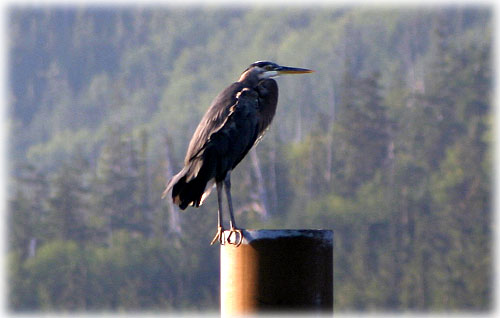 This blue heron was
recently photographed at rest at
This blue heron was
recently photographed at rest at
Ketchikan Airport's float plane dock.
The great blue heron is the largest and most common of the North
American herons. It is often seen standing at the edge of a tidal
pond watching for small fish, its favorite prey. It also feeds
on small mammals, reptiles, and occasionally, birds.
During the mating season, two
feathers on the bird's head become long and thread-like. The
great blue heron's eggs are generally light blue in color.
The clutch size is three to
seven eggs which are laid during March and April. Eggs hatch
after about 28 days, and both parents care for the chicks.
Their primary diet is small
fish, which they swallow head first. They also known to eat frogs,
lizards, snakes, crawfish, small birds, rodents, and insects.
The great blue heron can be
found in Alaska, Quebec, and Nova Scotia south to Mexico and
West Indies.
Lisa Thompson ©2005
View more of Lisa's Photos
E-mail Dick Kauffman:
editor@sitnews.org
Post a Comment View Comments
Submit
an Opinion - Letter
Sitnews
Stories In The News
Ketchikan, Alaska
|