 Portable hyberbaric chamber
can provide immediate treatment
Portable hyberbaric chamber
can provide immediate treatment
By Dick Kauffman
June 06, 2005
Monday
Ketchikan, Alaska - Commercial diving in Alaska can present many
life-threatening challenges, however Greg Harrison owner of Diversified
Diving Service of Ketchikan is making sure treatment for one
of those life-threatening challenges is immediately available.
According to Harrison, Diversified Diving will be using one of
the first portable hyberbaric chambers in this area for treatment
of decompression sickness.
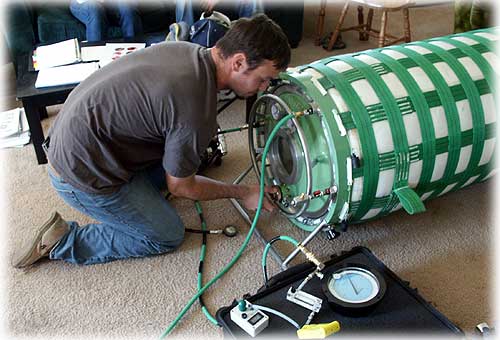 Portable Hyberbaric
Chamber
Portable Hyberbaric
Chamber
Adam Day, of Diversified Diving, receives training. Inside the
chamber
during the training was diver Alan Benitz of Ketchikan.
Photo by Dick Kauffman
This unique GSE (Giunio Santi Engineering) Portable Hyberbaric
Chamber is offered by Nautilus Underwater Systems. According
to information provided by Nautilus Underwater Systems, the portable
hyberbaric chamber is constructed of two aluminum alloy ends
with the cylindrical portion of the chamber made from two layers
of cloth. The inner layer is a gas bag made of a new composite
polyester cloth impregnated with urethane for better sealing.
The outer bag is a web net of cargo straps made of the same polyester
material. This provides strength against the gas pressure in
the inner bag and maintains the shape of the chamber. The concept,
says Nautilus Underwater Systems, is similar to an inner tube
in a tire, where the seal is provided by the inner tube (or gas
bag) and the shape is provided by the tire (or web bag).
The bends, a popular name for
a syndrome seen in deep-sea divers, is a very serious, potentially
lethal condition. Decompression sickness, the bends, arises from
too rapid a release of nitrogen from solution in the affected
diver's blood. If a diver surfaces too quickly, nitrogen that
had dissolved in the blood under increasing water pressure is
suddenly released, forming bubbles in the bloodstream and causing
pain (the 'bends') and paralysis. Sixty percent of your nervous
system is composed of fatty tissue. When the nitrogen stored
there turns into bubbles, it wreaks havoc. Nitrogen is also stored
in the joints - thus the name the bends - and directly under
the skin producing a blotchy rash. Immediate treatment is a gradual
decompression in a decompression chamber, while breathing pure
oxygen.
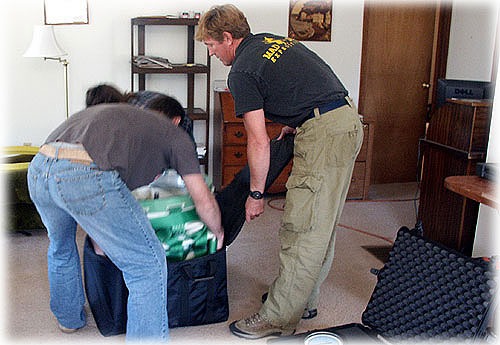 Training on properly
repacking the Portable Hyberbaric Chamber
Training on properly
repacking the Portable Hyberbaric Chamber
Adam Day and Andrew Driver, a representative
of Nautilus Underwater Systems from New York...
Photograph by Dick Kauffman
Diversified Diving's divers underwent additional training on
the portable hyberbaric chamber unit last Thursday. Andrew Driver,
a representative of Nautilus Underwater Systems from New York,
was in Ketchikan last week to assist with the training and answer
questions. Driver said, "The beauty of this system is that
is a portable system weighing 120 pounds. The normal chamber
one thinks of is a huge metal cylinder that weights 5,000 pounds."
Driver said if you don't get
the affected diver back under pressure immediately he could die.
With the ability to have the portable hyberbaric chamber unit
on board and readily available, Driver said the diver won't be
waiting long hours for a plane to fly in and transport him to
the nearest decompression chamber. A lot of damage can be done
in that wait time said Driver.
The bends, or decompression
sickness, is just one danger of diving. Other dangers include
nitrogen narcosis, oxygen toxicity and simple drowning if a diver
runs out of air before making it back to the surface. During
Thursday's training session, Diversified Diving demonstrated
to its staff that proper training, good equipment and careful
execution are the keys to safe diving.
On the Web:
Diversified Diving Service
E-mail your news &
photos to editor@sitnews.us
Publish A Letter on SitNews Read Letters/Opinions
Submit
A Letter to the Editor
SitNews
Stories In The News
Ketchikan, Alaska
|